



What is a Financial Controller? The Role & Keys to Effectiveness

What is a Financial Controller

Just as a conductor coordinates the musicians to create a harmonious symphony, a Financial Controller manages financial data, budgets, audits, and financial strategies to ensure a harmonious and financially sound organization.

In the finance department of a company, financial controllers manage the company’s money, whether it’s a small business or a big one. But what do they really do, and how can they do it well?

In this blog, we’ll explain the important job of a financial controller, what they need to be effective, and how they can be really good at it.

Why are Financial Controllers Important?

In a small business, the financial controller handles basic accounting activities like bookkeeping while performing more complex duties. These may include financial planning, budgets, and ensuring the corporation follows tax laws. In a larger company, the controller has even more tasks. They oversee the creation of detailed financial reports and audits. They also plan long-term financial strategies.

Their work is crucial since they identify financial risks and opportunities, guiding the company’s financial decisions. This role affects every part of a business and is critical to its financial health. This article will explore what a Financial Controller does, the skills they need, and why they are essential for a business’s success.

The Roles and Responsibilities of the Financial Controllers

A Financial Controller’s role extends significantly into financial controls and compliance, where the knowledge of accounting principles and accounting policies is crucial. In an era where regulations are tight and margins for error are slim, utilizing modern tech tools can be a game-changer.

In 2021, the Securities and Exchange Commission (SEC) alone collected $4.68 billion in disgorgements and penalties. A Financial Controller establishes rigorous internal controls to safeguard assets and ensure accurate financial reporting.

A controller regularly tests these internal controls. If issues arise, they take corrective action. Moreover, a Financial Controller manages the annual external audit, coordinating with auditors and providing necessary documentation. Modern technology can streamline this process, as digital records are easier to access and verify than paper-based systems.

A financial controller serves as the company’s gatekeeper of financial integrity. In today’s complex regulatory environment, they mitigate financial risk, uphold ethical conduct, and maintain investor confidence.

What Does a Financial Controller Do?

Let’s list the key responsibilities of a financial controller and understand why they are crucial.

Financial Reporting

Financial Controllers are responsible for generating vital financial reports quarterly and annually. These reports include balance sheets, income statements, and cash flow statements. Such documentation is crucial for stakeholders, providing a transparent view of the organization’s financial standing.

Budget Management

The financial controller role extends to budget management, which involves formulating budgets for different departments. When revenues are tight, controllers may need to cut budgets. Variance analysis allows controllers to compare actual spending against budgeted amounts, thereby minimizing negative impacts.

Internal Audits

Financial managers conduct internal audits, often employing continuous auditing techniques. This proactive approach enables the early detection of accounting differences. In one notable case, continuous auditing detected a compliance issue that saved a company from a potential $5 million fine.

Cash Flow Management

Financial officers also handle cash flow, focusing on both short-term and long-term strategies. Zero-based budgeting is often used to scrutinize all expenses, optimizing operational cash flow.

Analytical Assessments

SWOT analysis is a must-know for financial managers. For instance, before launching a new product, a controller uses SWOT to judge if it’s a money-maker or a sinkhole. Once, a controller’s SWOT uncovered a fierce competitor and changed the game plan.

Risk Management

Master Value at Risk (VaR). It’s a tool that shows you the worst-case scenario for losing money on an investment. Use it and cut risk by up to 20%, says the Journal of Finance. A top-notch controller needs sharp analysis, tech smarts, killer communication, and a good head for risk.

Read More: How Can Virtual Expense Cards Simplify Spending Control?

The Real Keys to Effectiveness: How to Improve?

The role of senior financial managers is quite challenging since the financial market keeps changing, and rules and regulations keep getting updated. Financial professionals need to constantly learn and improve their skills to cope with these changes. Let’s see how you should stay updated.

  • – Continuous Learning: In a world where Sarbanes-Oxley and GDPR are the rulebook, constant updates are your homework. Controllers, it’s non-negotiable. A CMA (Certified Management Accountant) certification is a requirement. Enhancing communication and leadership skills with effective collaboration, financial planning, negotiation, and leadership abilities is critical for exploring complex financial spaces.
  • – Strategies for Aspiring Controllers: Start with a finance or accounting course or any advanced degree in finance. Get early career experience in roles like ‘Financial Analyst’ or ‘Accounting Supervisor.’ Target that CMA certification by year three. It’s the puzzle piece that fits you into the controller spot. Skill up, walk a straight line, and plan like a general.
  • – Adapting to Change with Financial Tools: In today’s financial environment, the adaptability of a Financial Controller is essential. This isn’t merely about keeping pace with regulatory shifts such as Sarbanes-Oxley and GDPR but also involves the savvy use of advanced financial tools. You can also leverage data analytics and utilize the power of data to make informed financial decisions, identify trends, and uncover opportunities for improvement.

Therefore, adaptability serves as a cornerstone for effectiveness in the controller role. Technological advancements improve efficiency and solidify your standing as an astute financial strategist.

Read More: What is Expense Management Software?

The Bottom Line

Controllers manage tasks from financial reporting to risk management. This role isn’t just about crunching numbers; it’s about a long-term strategy for the whole company. A business’s financial health hinges on its expertise in financial control.

Automate Your Bookkeeping with Xpence

Xpence allows you to automate your time-consuming bookkeeping, where you just have to upload an invoice or a receipt. The software automatically categorizes the expenses and records accounting entries in the books. All you have to do is integrate with your accounting software to import the entries. Thus, it is a tech solution that reduces your time in posting journal entries while accurately recording all the expenses.

The Automated Bookkeeping has these salient features to streamline your company’s bookkeeping:

  • – Real-time auto-categorization of each financial transaction
  • – Stores digital receipts
  • – Provides insights into your business spending
  • – Saves time spent on categorization

Book your free Demo to manage your employee expenses more accurately and quickly.

Credit Card Reconciliation: How Automated Solutions Can Improve Your Business Efficiency?

According to World Bank data, credit card usage has surged globally, with over 74% of people employing these financial tools. They are pivotal in modern finance, offering convenience, cashless transactions, online shopping, and emergency funds. Canada leads with an 82.74% usage rate. 

Credit cards also assist in building credit history and offer rewards for better financial management. The global credit card market reached USD 489.4 billion in 2021, poised for substantial growth, projected to hit USD 961.2 billion by 2030, with a 7.78% Compound Annual Growth Rate (CAGR) anticipated from 2023 to 2030.

What is Credit Card Reconciliation?

Credit card reconciliation is a systematic financial process that ensures accuracy between credit card statements and accounting records. It involves

  • – Data Collection: This is the initial step in the credit card reconciliation process. It involves gathering all relevant financial documents, primarily credit card statements, and supporting receipts. These documents are essential for ensuring that all transactions are accurately accounted for.
  • – Comparison: Once the data is collected, the next step is to compare each credit card transaction with corresponding entries in the company’s accounting records. This comparison is crucial to verify that all transactions on the credit card statement are accounted for in the company’s financial records. It helps identify any discrepancies or missing transactions.
  • – Discrepancy Resolution: Discrepancy resolution is a critical phase of the reconciliation process. It involves investigating and resolving any inconsistencies or discrepancies during the comparison step. Discrepancies may include errors in transaction amounts, double entries, missing receipts, or unauthorized charges.
  • – Record Updates: After resolving discrepancies, the reconciliation process requires accurately updating the company’s accounting records to reflect the reconciled data. This step ensures that the financial records accurately reflect the company’s financial position, accounting for all credit card transactions.
  • – Payment Recording: Payment recording involves documenting credit card payments made by the company. This step ensures that credit card payments are properly recorded in the company’s financial records, reducing outstanding balances and ensuring accurate financial reporting.
  • – Reporting: The final step of credit card reconciliation involves generating reports to analyze and document the reconciliation process. These reports provide a comprehensive overview of the reconciliation efforts, including details on any discrepancies found and how they were resolved. Reporting is essential for maintaining transparency and accountability in financial management.

This systematic approach guarantees financial accuracy, fraud detection, and sound expense management, making it a crucial practice for individuals and businesses. Automation tools enhance efficiency in this process.

Challenges and Solutions with Credit Card Reconciliation

Credit card reconciliation is vital for financial accuracy. It ensures tracking expenses, detecting errors, and preventing fraud. Moreover, it helps maintain a healthy credit score and budget management. This practice is necessary to avoid financial chaos and missed opportunities for savings and growth.

Challenges Solution
Transaction Discrepancies: Inaccurate transaction recording leads to discrepancies between records and statements. Automation: Implement reconciliation software for real-time tracking and error reduction.
Late Reconciliation: Delays in reconciling credit card statements can result in missed payments or interest charges. Receipt Management: Digitize receipts, use expense tracking apps, and encourage timely submission.
Missing Receipts: Difficulty in locating or obtaining receipts for certain expenses. Set Deadlines: Establish regular reconciliation schedules and enforce timely reporting.
Employee Fraud: Unauthorized or fraudulent charges by employees can go unnoticed. Internal Controls: Implement strict expense policies and conduct periodic audits to deter fraud.
Data Entry Errors: Manual data entry leads to typographical errors and misreporting. Data Validation: Employ double-checks and validation protocols to minimize data entry errors.
Hidden Fees: Failure to notice and account for hidden fees on credit card statements. Thorough Review: Scrutinize credit card statements for hidden fees and discrepancies during reconciliation.

Automated Credit Card Reconciliation with Xpence 

Xpence simplifies expense reconciliation with automated card management. With Xpence cards, you can reconcile them effortlessly without spending much time on it. 

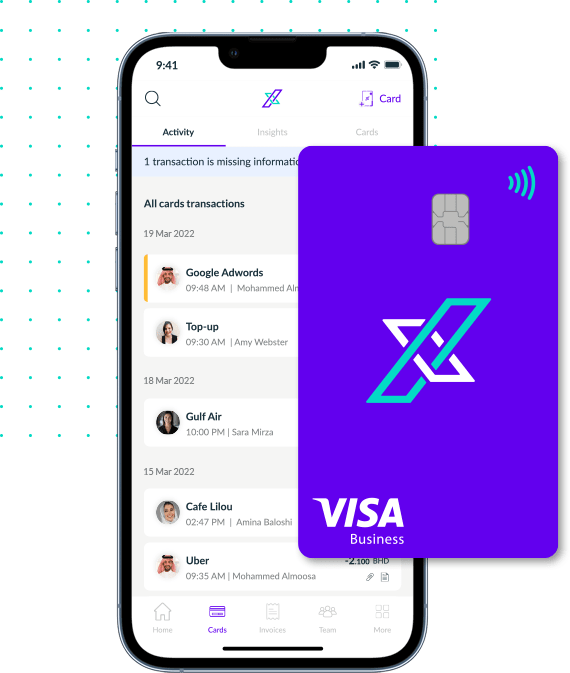
Xpence allows you to issue multiple cards to your employees with varying spending limits. With Xpence cards, you receive instant notifications regarding expenses. You can promptly approve or reject employee expenses, resulting in faster reimbursements and an improved employee experience.

4 Reasons Why You Should Switch to Automated Solutions

When it comes to credit card reconciliation, transitioning to an automated solution, like the virtual card we offer, can be a game-changer for businesses in the UAE. Here are compelling reasons to switch:

Real-time Card Statements for Instant Insights

Dealing with delayed credit card statements can frustrate and hinder effective financial management. Our virtual card solution offers a dashboard where all card spending is consolidated and updated, providing real-time access to transaction information whenever needed.

You can effortlessly track every payment, see who initiated and approved each transaction, identify the supplier, view attached receipts, and understand the reasoning behind each expenditure. The days of chasing down mysterious payments are a thing of the past.

Better Card Control

Having a shared company credit card can be problematic and pose a risk of fraud. When too many people have access to a single card, it becomes challenging to track who makes purchases. This lack of transparency can result in financial discrepancies and even security concerns.

Our virtual card solution offers a revolutionary approach. Each user is assigned an individual virtual card with personalized spending limits. This means that managers or the CFO can exercise precise control over expenses. Specific purchases can be approved or declined, and spending limits can be adjusted for individuals or teams.

With every payment logged in real-time, you always have a clear picture of who is spending within the defined limits. This level of control minimizes the risk of unauthorized or excessive spending, ensuring financial accountability within your organization.

Streamlined Receipt Management with Mobile Integration

Traditional credit card receipts can be a headache for bookkeepers, often arriving long after the transaction and being susceptible to loss or damage due to their paper format.

Our virtual card solution lets your team members access a mobile app that simplifies the receipt management process. At the point of purchase, users can effortlessly snap photos of their receipts, ensuring they can access these critical documents well before they can be misplaced or deteriorate.

Even better, if a team member needs to remember to capture a receipt, they can be promptly reminded via Slack, email, or the app. This proactive approach has resulted in an impressive 98% receipt collection rate for most users, making reconciliation smoother than ever.

Effortless Automated Reconciliation

Say goodbye to the era of paper-based finance processes. Our virtual card solution enables the submission of payment details and receipts in digital format, eliminating the need for time-consuming data entry tasks for your finance team.

The reconciliation process can be almost entirely automated. Spend management software takes care of itemizing and categorizing expenses, and a simple export sends this organized data to your accounting tools.

No more sifting through spreadsheets or comparing paper card statements to computer screens. Our software matches card payments against your ledger, highlights duplicates, and flags inconsistencies. The result? Days of manual work saved, and a streamlined, error-free reconciliation process.

Conclusion

In summary, credit card reconciliation is a vital financial practice that ensures accuracy and transparency in managing one’s finances. It involves aligning credit card statements with accounting records, resolving discrepancies, and maintaining financial integrity. Automated tools simplify this process, reducing errors and enhancing efficiency. 

By diligently reconciling credit card transactions, you can track expenses, detect fraud, and make informed financial decisions, ultimately contributing to better financial health and management of your business.

9 Key Benefits of Business Financial Planning

Business Financial Planning

Financial Planning is a detailed strategy that includes short-term budgeting and long-term forecasting while assessing risks that could throw you off course. 

The rapid ups and downs in the stock market and general economic unpredictability highlight the importance of a sound financial plan. 

Whether running an SME, a large-scale business, or even a company, financial planning can help in endless ways. How?

Let’s dig deeper into how it can help you elevate your business performance and support you in making sound financial decisions.

9 Ways Financial Planning Elevates Business Performance

1. Refines Liquidity Management

Big or small, financial planning is the backbone of any business. The key goal is to understand your financial health to make informed decisions. One unique aspect is liquidity management, ensuring the business consistently has enough cash to meet its short-term obligations. This is crucial for maintaining good relationships with suppliers and employees, affecting your business reputation and operational efficiency.

2. Generates KPIs in Real-time

A continuous picture of the company’s financial health may be obtained via financial planning, enabling organisations to establish and monitor key performance indicators in real time. That way, you can rapidly change the strategy by shifting funding to a more fruitful division or eliminating a cost centre that needs to produce a return on investment.

3. Evaluates Financial Viabilities

In a corporate setting, financial planning takes on a strategic role, especially in decision-making related to market expansion, mergers, and acquisitions. It provides a framework for evaluating the financial viability of these strategic moves. For example, it can help a corporation decide whether to enter a new market organically or through an acquisition based on projected costs, risks, and potential returns.

4. Generates Investor-centric Results

Let’s talk about the startups and new ventures where financial planning can make or break their success.

  • – When you’re in the early stages, a well-crafted financial plan shows potential investors and partners that you’re not just passionate but also pragmatic and prepared. This can tip the scales in your favour during negotiations.
  • – New businesses often miss out on tax benefits simply because they’re unaware of them. A good financial plan can help you identify these early on. For example, you might qualify for R&D tax credits or specific deductions for home office expenses, which can be significant in the startup phase.
  • A financial plan helps you foresee potential cash crunches and allows you to make arrangements in advance, whether negotiating better payment terms with suppliers or planning a short-term loan.

Check Corporate Virtual Card For Business Expenses solution

5. Tool for Opportunity Cost Analysis

When integrated with business strategy, financial planning can serve as a tool for opportunity cost analysis. This means you can quantify what you might lose in one area by investing in another, helping you make more informed decisions. For instance, it can help you decide whether the cost of delaying a product launch to perfect its features will outweigh the benefits of hitting the market early.

6. Identifies Cashflow Gaps

A robust financial plan can help small businesses identify seasonal cash flow gaps and prepare for them in advance. This is crucial for industries like retail or agriculture, where cash flow can be highly seasonal. Another overlooked benefit is debt structuring. Small businesses often take whatever credit terms they can get, but a financial plan can help you negotiate terms matching your cash flow cycles, reducing interest costs.

7. Efficient Capital and Resource Allocation

For established companies, financial planning offers the advantage of predictive budgeting, resource allocation, and more. Here’s how financial planning for a business works:

  • Predictive Budgeting

    Utilising historical data and financial planning allows established companies to create highly accurate budget forecasts.

  • Resource Allocation

Precise budgeting enables better resource allocation, helping to identify areas where returns may be diminishing.

  • Capital Allocation Efficiency

A well-crafted financial planning corporate strategy guides decisions on reinvesting in the business, buying back shares, or increasing dividends to maximise shareholder value.

8. Acts as a Risk Mitigation Matrix

In the entrepreneurial context, financial planning in accounting is a risk mitigation matrix. It helps you identify the high-reward opportunities and the high-risk areas that need contingency planning. This is crucial for startups that operate in volatile markets, highlighting why business finance is essential. Another unique benefit is milestone-based funding, where the financial plan breaks down the venture’s growth into measurable milestones, making it easier to secure stage-specific funding.

9. Anticipates Crisis on Time

Seeking professional financial advice offers the benefit of crisis anticipation. Advisors can often spot financial red flags long before they become a crisis, allowing for preemptive action. Another advantage is strategic tax planning, where the advisor can help structure the business transactions and operations to minimise tax liability. This is a crucial aspect of financial planning and strategy, which can save a significant amount of money in the long run.

Conclusion

Financial planning serves different roles in various business settings. Effective financial management acts like a real-time control system for quick and informed decisions. Whether you’re dealing with a financial plan for a new business or managing an established corporation, the importance of financial planning can’t be overstated. So, whether you’re crafting a small business financial plan or overseeing a large corporate budget, the benefits are too noticeable to ignore.

Explore more about: Business Financial Planning Solution

Plan Your Expenses with Xpence

The purpose of a financial plan is to guide you through the complexities of business finance and predict the expenses before they occur.

Xpence provides an expense management solution where you can issue virtual and physical cards to your employees and control their business spending. 

When the expenses are well-managed, the reimbursement process isn’t delayed since the expense policies are recorded in the software, automatically verifying whether an expense claim is in order with the policy.

Strategies to Develop Effective Accounts Payable Management Procedures in 2023

Payable Management Procedures

Accounts payable, the company’s financial obligations to its suppliers, are critical to business operations. As we approach 2023, the dynamics of managing trade payables are shifting. Technological advancements, regulatory changes, and global economic factors reshape how businesses handle payables.

Efficiency, compliance, and strategic financial planning are more crucial than ever. Understanding these aspects and adapting to the new landscape can lead to significant cost savings, improved supplier relationships, and a more streamlined financial workflow.

What is Accounts Payable?

Accounts payable is an accounting term for a company’s debt to suppliers for receiving goods and services on credit. It is a crucial part of a business’s current liabilities that should be paid in less than 12 months.

The accounts payable process flow includes receiving the original invoice, verifying details, approving payment, and finally making the payment. This account payable process flow ensures that the payment process is accurate and timely.

Importance of Effective Accounts Payable Management

Managing trade payable is not just about paying bills. It plays a strategic role in a company’s cash flow, short-term obligations, and vendor relationships.

Proper accounts payable process helps negotiate favorable terms with suppliers and maintain good relationships. It also plays a vital role in risk mitigation since effective management of trade payables reduces short-term liabilities.

Effective management of accounts payable can help companies to

  • – Optimize early payment discounts,
  • – Avoid late fees,
  • – Prevent fraud.

Benefits of Streamlining Accounts Payable Processes

Automating accounts payable processes can transform financial operations and benefit businesses.

Cost Savings 

Streamlining accounts payable workflow through automation reduces errors, saves costs, and improves cash flow management by freeing up human resources for strategic activities.

Compliance 

Organized accounts payable processes ensure compliance with regulations and protect financial stability. It also helps to build a reputation for trustworthiness and ethical financial management, increasing stakeholder confidence.

Enhanced Vendor Relationships 

Paying suppliers on time builds trust and reliability, leading to better partnerships, discounts, and opportunities for both parties.

Visibility and Analytics 

Improved accounts payable processes provide valuable insights through data analytics and reporting, empowering decision-makers with strategic information for optimizing financial operations.

Strategic Resource Allocation 

Efficient processes free up time and resources for strategic initiatives. Finance teams can analyze data, optimize cash flow, and find cost-saving opportunities, contributing to an organization’s growth.

Transparency 

Efficient accounts payable processes ensure transparency and accountability with detailed approvals, payments, and communications documentation. This creates a robust audit trail and reinforces internal controls for smoother audits.

Risk Mitigation 

Automating and streamlining processes can help mitigate risks. By eliminating manual errors and data discrepancies, organizations can reduce the risk of fraud that could result in financial loss or reputational damage. Consistent processes also provide predictability, enabling organizations to address potential issues proactively.

Innovation 

Efficient accounts payable processes are crucial for business growth. Streamlined operations save resources and promote innovation. They can also quickly adapt to meet changing needs.

AP Procedures and Processes

Compelling accounts payable management requires precise and efficient execution of crucial steps. Here’s a breakdown:

  • – Invoice Receipt: Receiving and recording invoices from vendors.
  • – Vendor Invoice Verification: Ensuring seamless invoice processing that matches purchase orders and delivery notes.
  • – Approval Workflow: Routing the outstanding invoice for necessary approvals within the organization as part of approved accounting policies.
  • – Payment Scheduling: Determining the payment date based on terms and conditions.
  • – Payment Execution: Making the invoice payments through the preferred method.

Potential pitfalls in these steps include errors in data entry, delays in approval, and failure to comply with payment terms. 

However, proper account payables management and attention to detail can help avoid these common mistakes.

Developing Efficient Accounts Payable Procedures

Creating compelling accounts payable procedures is not a one-time task. It requires

Clear Guidelines Document the AP process, including roles, responsibilities, and timelines.
Regular Audits Conduct periodic reviews to identify bottlenecks and areas for improvement.
Updates and Training Keep the procedures up-to-date and train staff on any changes.
Collaboration Foster cross-functional collaboration to enhance transparency and communication.
Use Metrics Tracking key metrics like time used to process APs, error rates, and turnaround times through expense reports provides insights into the efficiency of accounts payable operations.
Compliance Robust compliance measures safeguard against financial risks and instil confidence in stakeholders.
Documentation Each step, decision, and approval should be meticulously recorded, creating an audit trail that ensures accountability and transparency.

The account payable procedure must be dynamic, adapting to changes in the business environment and regulatory landscape. Continuous improvement is vital to maintaining efficiency and compliance in AP processing.

Tips for Optimizing AP Processing in 2023

  • – Technology Utilization: Leveraging tools like AI, automation, and cloud-based solutions to streamline processes.
  • – Training and Collaboration: Investing in staff training and fostering collaboration between departments to ensure a smooth workflow.
  • – Integration: The focus should be on integrating technology with human expertise to manage accounts payable effectively.
  • – Automation Solutions: Digitizing invoices and documents reduces clutter and expedites processing. Cloud-based document storage ensures easy accessibility and eliminates the risk of physical document loss.
  • – Streamlining Workflow: Implementing a robust system for organizing and prioritizing invoices can prevent delays and bottlenecks. Streamlining your workflow ensures that each process step is optimized for maximum efficiency.
  • – Fraud Controls: Establishing reliable fraud detection mechanisms safeguards your finances and prevents unauthorized activities. Implementing multi-factor authentication and encryption protocols protects your accounts payable process more.
  • – Standardize Payment Terms: Standardizing payment terms minimizes confusion and prevents errors. Precise, uniform payment terms ensure consistency in processing and foster a transparent relationship with vendors.

Managing Accounts Payable Effectively

Managing accounts payable is no longer just about paying bills on time. It requires proactive management, including strategies for forecasting, vendor negotiation, and leveraging technology. 

Automation plays a vital role in enhancing efficiency, and Robotic Process Automation (RPA) is at the forefront of this transformation.

Xpence offers an automated expense management solution that streamlines account management processes and provides valuable insights without remembering to follow up since the solution automatically sends reminders.

Conclusion

Accounts payable management can impact a company’s relationships, reputation, and bottom line. The trends and strategies discussed here reflect the dynamic nature of AP and the need for proactive management. 

Leveraging automation, cloud solutions, and sustainable practices will be crucial to success in 2023. Businesses must be ready to adapt and innovate, leveraging these insights on managing trade payable effectively and staying ahead in the competitive market. The future of accounts payable workflow is bright, and the time to act is now.

FAQs

What is an example of accounts payable?

Items of current liabilities, like outstanding bills, creditors, outstanding business expenses, outstanding office expenses, etc., are examples of accounts payable.

What is an AP invoice?

An AP invoice is the documentation of a supplier invoice to request payment to the payable team of the company. 

What is the difference between AP and AR?

While the AP is the money payable to the suppliers for the services or goods received, the accounts receivables are the money from the customers for the services or goods provided.

What are the types of accounts payable?

A company may have trade payables, non-trade payables, loan payables, salary payables, etc.